陌生人
- Year
- 2023
- Medium
- 油画布
- Dimensions
- 80 × 120 × 4 cm
- Style
- 现代
- Price
- £8,000
- Availability
- Price on application
Availability is managed directly by the artist or authorised representative.
About this artwork
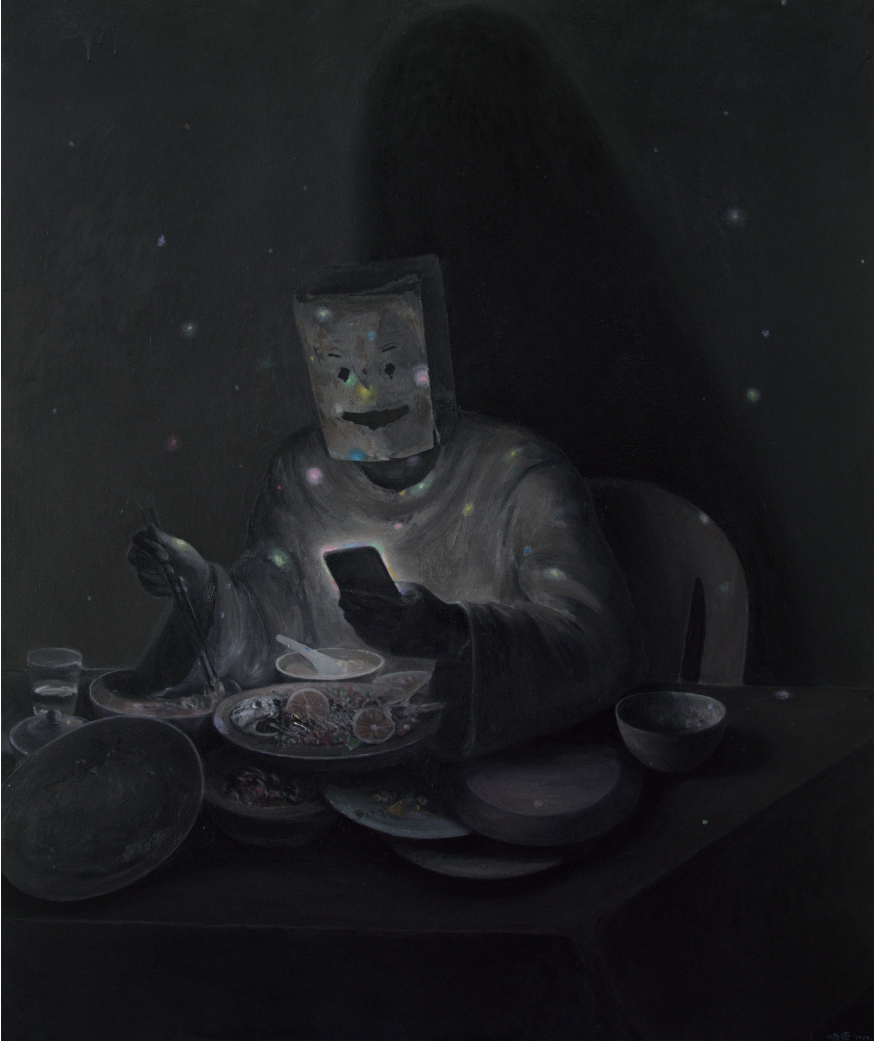
The Stranger depicts a solitary figure seated at a dining table in an almost entirely dark interior. The figure wears a roughly constructed, mask-like covering that obscures individual identity, while the dim light of a mobile phone illuminates the hands and part of the body. Scattered plates, bowls, glasses, and leftover food occupy the foreground, suggesting that a meal has recently taken place or is still unfinished. Yet despite the abundance of objects, the atmosphere remains empty and emotionally distant. Small points of coloured light appear across the figure and surrounding darkness, resembling reflections, digital pixels, distant stars, or fragments of memory. These subtle marks interrupt the heavy blackness of the painting and create an ambiguous space between physical reality and an imagined, psychological world. The muted palette, restrained brushwork, and limited illumination heighten the sense of silence and isolation. The composition presents an ordinary domestic scene while making it strangely unfamiliar. The figure is physically present but emotionally withdrawn, transforming a familiar act of eating and looking at a phone into an image of solitude, disconnection, and contemporary alienation.
The concept of Stranger begins with my observation of loneliness and emotional distance within contemporary everyday life. Digital technology has created unprecedented possibilities for communication, yet constant connection does not necessarily produce intimacy. People may sit at the same table, inhabit the same room, or remain continuously connected through screens, while still experiencing a profound sense of separation. In this painting, the masked figure represents both an individual and an anonymous contemporary subject. The face is concealed in order to weaken specific identity and suggest the possibility that the “stranger” could be anyone, including ourselves. The mobile phone becomes the brightest source of light in the composition, symbolising the way digital devices increasingly mediate our attention, relationships, and perception of reality. The remnants of food and domestic objects refer to physical life, routine, and human presence, while the scattered coloured lights suggest another invisible space—perhaps the digital world, memory, desire, or emotional projection. By placing these two realities together, I wanted to explore the tension between connection and isolation, familiarity and estrangement, presence and absence. Stranger is ultimately a reflection on how people may gradually become unfamiliar to others, and even to themselves, within contemporary life.